Future Space Technologies: Key NASA Innovations Required for a Permanent Moon Base
NASA and global researchers are developing seven critical technologies to make a permanent human settlement on the Moon feasible and sustainable.
 🎭Culture & Sport
Photo: RBC-Ukraine
Key points
- NASA focuses on seven essential technologies for lunar habitation
- Lunar Reactor-1 targeted for delivery by 2030
- ISRU approach aims to utilize local lunar water and regolith
- New shielding solutions designed against radiation and abrasive lunar dust
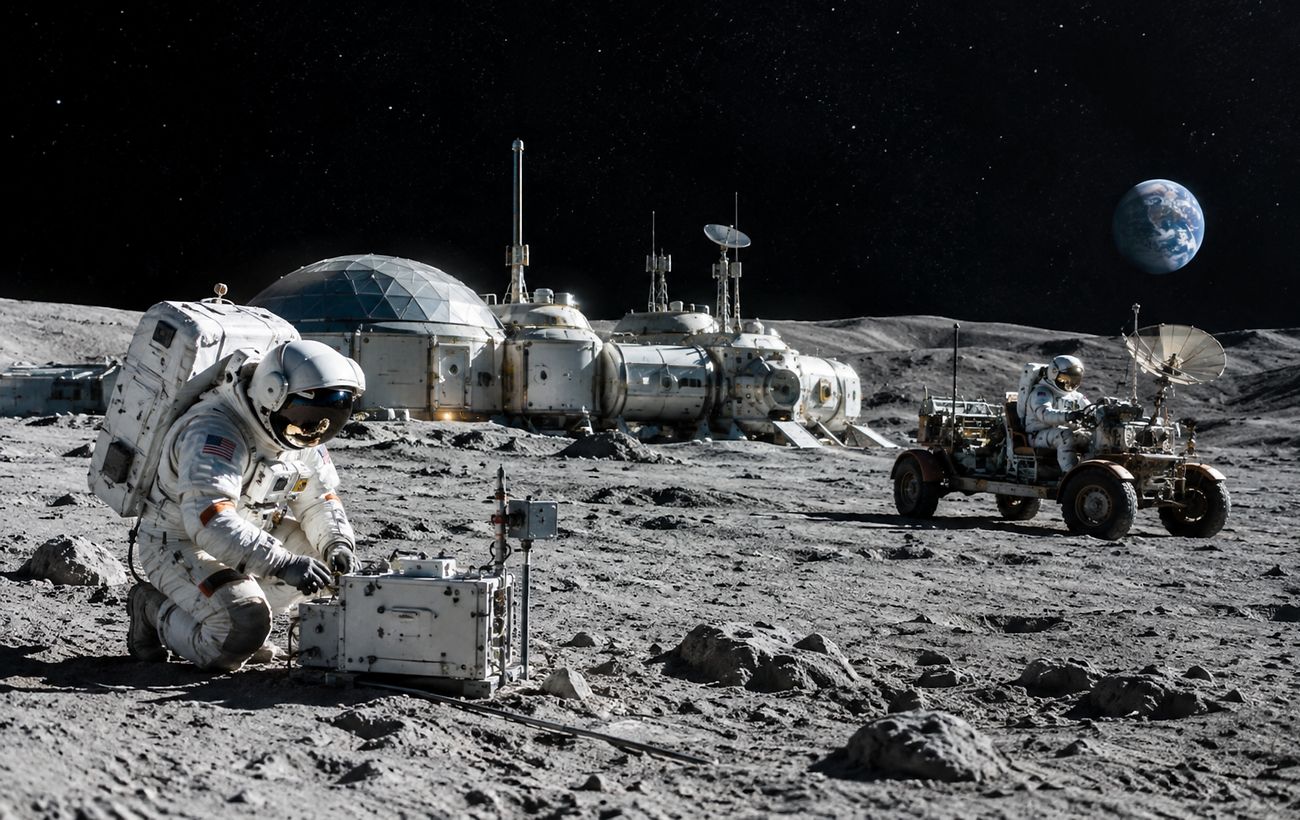
Establishing a permanent base on the Moon requires overcoming monumental engineering hurdles, ranging from reliable shelter construction to energy generation and life support. NASA, alongside international scientific teams, is actively developing seven foundational technologies without which prolonged human presence on Earth's satellite would be impossible.
Power Generation and Resource Utilization
Traditional solar arrays alone cannot sustain a lunar colony due to the prolonged lunar day and night cycle, lasting roughly fourteen Earth days each. To counter this, engineers are designing vertical solar panels, radioisotope generators, and compact nuclear reactors. NASA aims to deliver the Lunar Reactor-1 by 2030 to guarantee a stable power supply regardless of environmental conditions.
Furthermore, relying entirely on supplies from Earth is economically unviable, making the In-Situ Resource Utilization (ISRU) approach crucial. Researchers are targeting water ice deposits at the lunar south pole for life support and rocket fuel production, while also extracting oxygen from local regolith. Advanced closed-loop life support systems must similarly recycle water and air efficiently over years of autonomous operation.
Overcoming Space Hazards
Lunar dust poses severe mechanical and health risks due to its abrasive edges and electrostatic charge, though recent tests with electrodynamic dust shields show promise. Additionally, the lack of an atmosphere and magnetic field exposes astronauts to intense cosmic radiation, prompting plans to shield habitats with thick layers of local regolith.
Source RBC-Ukraine — rbc.ua/ukr/news/vid-dernogo-reaktora-5g-shcho-potribno-nasa-1794836… ↗
Read next
 🚌Transport
Belgium to Temporarily Close Airspace Due to Nationwide Strike
Air traffic in Belgium will be completely paralyzed on Monday as air traffic controllers join a nationwide protest against austerity measures.
 💼Economy
Russian Vessel Sparta II Continues to Burn in the Gulf of Finland Following Drone Attack
Rescue operations are ongoing in Finnish territorial waters to extinguish a fire on the Russian cargo ship Sparta II after a drone strike.
 💼Economy
How to Make Terry Towels Soft Again: A Simple Household Trick
Over time, terry towels can become stiff due to hard water and detergent buildup. A simple two-step washing method using salt and citric acid can restore their original f…
 🛡️Security
Airstrike on Dymer in Kyiv Region: 14 People Missing After Apartment Building Destroyed
A nighttime drone attack on the town of Dymer in the Kyiv region heavily damaged an apartment building, leaving 14 residents unaccounted for.
 🚌Transport
Logistical Challenges and Transport Nuances of Ukrainian Theatre Tours Abroad
Organizing theatre tours across Europe involves complex logistical hurdles, where a single transport delay can disrupt the entire schedule.
 🩺Health
Winter Trap for Animals: Police Urge Drivers to Check Cars Before Every Trip
As temperatures drop, stray animals often seek warmth under car hoods. National Police remind drivers of simple safety habits to protect urban wildlife.